
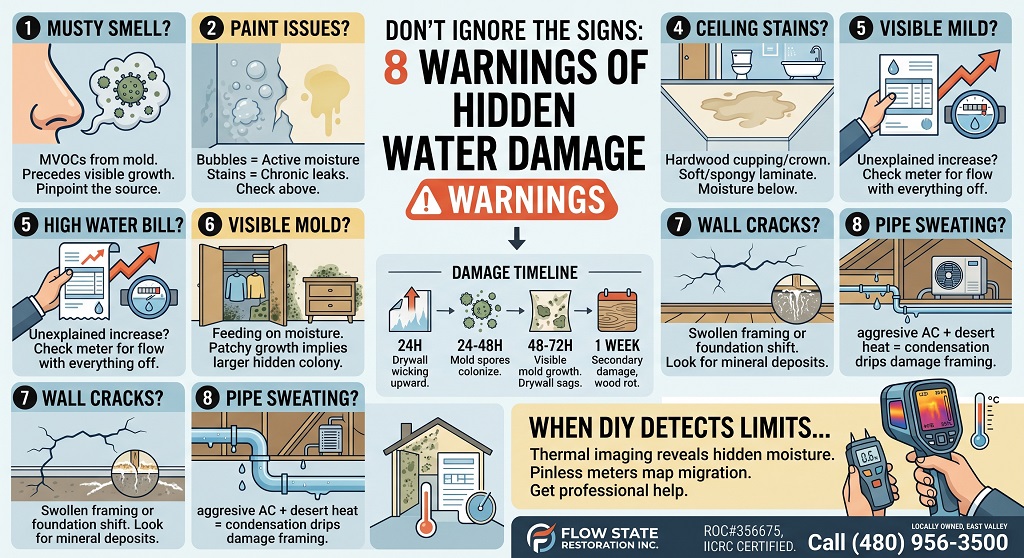
Catching water damage early is the entire game. This guide covers the warning signs that most homeowners either miss entirely or dismiss as “just one of those things old houses do.”
The Musty Smell Nobody Can Pinpoint
This is usually the first sign, and the most commonly ignored. A persistent musty or earthy odor that doesn’t go away no matter how much you clean. It’s not the garbage disposal. It’s not the laundry hamper. It’s that damp, almost soil-like smell that seems to live in a specific area of the house.
What you’re smelling is microbial volatile organic compounds (MVOCs). Mold and bacteria produce these gasses as they break down organic materials like drywall paper facing, wood framing, and carpet backing. The smell shows up well before you ever see visible mold growth.
Pay attention to where the smell is strongest. If it intensifies near a specific wall, under a bathroom vanity, or around a window frame, that’s your search area. Smell is weirdly reliable as a diagnostic tool because your nose can detect MVOCs at concentrations far below what any visual inspection would reveal.
Bubbling, Peeling, or Discolored Paint
Paint is essentially a moisture barrier on the surface of your walls and ceilings. When moisture builds up behind it, the bond between paint and substrate starts to fail. This shows up in a few ways, and most homeowners chalk it up to a bad paint job or normal aging.
Bubbling or blistering paint means moisture is pushing outward from behind the surface. This is active moisture. Not something that happened once and dried out. If paint is bubbling, water is still present or recurring in that area.
Peeling or flaking paint, particularly in bathrooms, kitchens, or along exterior walls, can indicate chronic moisture exposure. In bathrooms, poor ventilation is a common culprit. But peeling paint on a living room wall that shares a plumbing chase with the bathroom is a different story entirely. That’s not a ventilation issue. That’s a leak.
Discoloration is the one people notice but explain away. Yellowish or brownish stains on ceilings or upper walls almost always indicate water that has traveled from somewhere above. Roof leaks, HVAC condensation line overflows, and second-floor plumbing failures all present this way. The stain might dry out and look faded, which leads homeowners to think the problem resolved itself. It didn’t. The water source is still there. It’s just between active leak cycles.
One detail worth noting. If you paint over a water stain without addressing the source, the stain will bleed through again. Stain-blocking primer can mask it cosmetically, but the underlying moisture problem remains and continues to damage the structural materials behind the surface.
Warped, Buckled, or Spongy Flooring
Flooring is one of the most reliable indicators of hidden water damage because it reacts physically to moisture in ways you can both see and feel.
Hardwood floors cup or crown when moisture hits them unevenly. Cupping is when the edges of individual boards rise higher than the center, creating a concave profile. This happens when moisture is coming from below (a slab leak, a crawl space issue, or a supply line failure under the floor). Crowning is the opposite, where the center of the board is higher than the edges, and it typically happens after a surface water event or if a cupped floor was sanded before the moisture issue was resolved.
Laminate and engineered wood flooring will buckle, swell at the seams, or develop a spongy feel underfoot. If you’re walking across a room and one section feels softer or bouncier than the rest, there’s moisture underneath. Laminate is particularly reactive because the fiberboard core absorbs water aggressively. Once it swells, it doesn’t go back.
Tile floors can signal hidden water damage too, just more subtly. Loose tiles, cracked grout lines, or tiles that sound hollow when tapped can all indicate that the substrate underneath (typically cement board or a mortar bed) has been compromised by moisture. In Arizona homes built on slab-on-grade foundations, a slab leak can push moisture up through the concrete and deteriorate the tile substrate from below without any visible water on the surface.
Vinyl flooring is tricky because it’s waterproof on the surface, so water from below gets trapped. Look for edges curling up, seams separating, or discoloration visible through translucent vinyl. Peel back a corner if you can. If the subfloor underneath is dark, swollen, or smells musty, you’ve found it.
Stains and Soft Spots on Walls and Ceilings
Not every wall stain is water damage. But a surprising number of them are, and homeowners tend to underestimate what a small stain on a ceiling actually represents.
Water travels. It follows the path of least resistance, which means the stain on your living room ceiling might not be directly below the leak source. Water can run along a joist, travel several feet horizontally, pool at a low point, and then soak through the drywall there. The actual leak could be five or six feet away from where the stain appears.
Press on the stained area with your finger. If the drywall feels soft, gives under pressure, or feels cooler than the surrounding surface, there is active or recent moisture present. Drywall that has been wet and dried repeatedly loses structural integrity over time. It becomes chalky and crumbly. Even if it looks okay from a distance, a finger test will reveal how compromised it actually is.
Ceiling stains in single-story homes with attic space often trace back to HVAC issues. Condensation drip pans overflow. Ductwork sweats when there’s a temperature differential and insufficient insulation. The secondary drain line clogs and nobody notices because the primary is still working. All of these dump water into the attic space, where it eventually makes its way down through the ceiling drywall.
In two-story homes, ceiling stains on the first floor usually mean a plumbing issue on the second floor. Toilet wax ring failures are extremely common and can leak small amounts of water over months before producing a visible stain below. Same with shower pan failures, which can weep water through the subfloor every time someone showers.
Unexplained Increases in Your Water Bill
This one gets overlooked constantly. If your water bill has crept up over the past few months without a corresponding change in usage, you might have a leak somewhere in your supply lines.
A running toilet can waste 200 gallons per day. A pinhole leak in a copper supply line behind a wall can be even worse because it runs 24 hours a day with no noise or visible indicator. The water just saturates the framing and insulation inside the wall cavity, doing damage you won’t see until it’s extensive.
Check your water meter. Turn off every water-using fixture and appliance in the house. Don’t run the dishwasher, washing machine, or any faucets. Then go look at the meter. If the flow indicator is still moving, water is going somewhere it shouldn’t be. Some meters have a small triangle or diamond that rotates to indicate even very low flow rates. If that indicator is spinning with everything shut off, you have a leak.
Supply line leaks in slab-on-grade homes (which is the dominant foundation type across Gilbert, Chandler, Mesa, and most of the East Valley) are particularly insidious because the pipes run under or through the concrete slab. A slab leak can run for months before it saturates enough material to produce a visible indicator like a warm spot on the floor or a crack in the foundation. By the time you notice, the damage area is often much larger than expected.
Visible Mold or Mildew in Unusual Places
Finding mold in a shower corner isn’t alarming. That’s surface mold from humidity, and regular cleaning handles it. Finding mold on a bedroom wall, inside a closet, along a baseboard, or on the underside of furniture pushed against an exterior wall is a different situation entirely. That mold is feeding on moisture that shouldn’t be there.
Mold needs three things: moisture, an organic food source, and time. Most building materials (drywall, wood, carpet, insulation) provide the food source. Arizona’s desert climate provides the warm temperatures. The only variable is moisture. If mold is growing somewhere it shouldn’t, that location has a moisture source, and finding that source is more important than cleaning the mold off the surface.
Small patches of mold on walls or baseboards often indicate a much larger colony behind the surface. Mold grows in the direction of its food source. What you see on the front of the drywall is the visible edge of a colony that may extend across the entire back side of the panel and into the wall cavity. Cleaning the visible mold without addressing the moisture source and the hidden growth is cosmetic, not remediation.
Black, green, or white fuzzy growth in closets or behind furniture is a red flag for poor air circulation combined with a moisture source. Sometimes it’s condensation on an exterior wall (common when air conditioning creates a significant temperature differential between interior and exterior surfaces). Sometimes it’s a slow plumbing leak in the wall behind. The fix depends entirely on identifying the moisture source.
Cracks in Walls, Ceilings, or Foundation
Not every crack is water-related. Houses settle. Seasonal temperature changes cause expansion and contraction. But certain crack patterns can indicate water damage to structural components.
Horizontal cracks along drywall seams, particularly on walls adjacent to bathrooms or kitchens, can indicate that the framing behind the wall has swollen from moisture exposure. Wood framing that absorbs water expands. As it expands, it stresses the drywall joints and tape, producing cracks that look like settling but are actually moisture-driven.
Diagonal cracks radiating from window and door corners can indicate foundation movement caused by expansive soil conditions. When the soil around a slab-on-grade foundation gets saturated (from irrigation, poor drainage, or a slab leak), it expands and puts upward pressure on the foundation. When it dries, it contracts and the foundation settles. This cycle produces cracking in the drywall above as the structure shifts.
Foundation cracks themselves deserve attention. Hairline cracks in a slab are normal. Cracks wider than 1/8 inch, cracks that are growing, or cracks accompanied by efflorescence (that white crystalline deposit on concrete surfaces) indicate moisture is actively moving through the concrete. Efflorescence means water is dissolving mineral salts inside the concrete and depositing them on the surface as it evaporates. Where there’s efflorescence, there’s water.
Condensation, Sweating Pipes, and HVAC Issues
Arizona homeowners deal with a specific set of moisture challenges that don’t get talked about enough. The desert climate is dry outdoors, but indoor environments with aggressive air conditioning create conditions where condensation becomes a real problem.
When the difference between the outdoor temperature (110+ degrees in summer) and the indoor temperature (set to 76 or lower) is extreme, cold surfaces attract moisture from any humid air that gets inside. This is why you sometimes find condensation on windows, on the undersides of HVAC ductwork in attics, and on cold water supply pipes.
Sweating cold water pipes are particularly problematic because they can drip for years inside wall cavities without anyone knowing. The pipe itself isn’t leaking. It’s condensation forming on the outer surface of the pipe and dripping onto whatever is below it. Over time, this moisture is enough to saturate insulation, grow mold, and damage framing.
HVAC systems are another hidden moisture source. A clogged condensate drain line, a cracked drip pan, or ductwork that’s losing conditioned air into an unconditioned attic space can all introduce moisture into areas where it causes long-term damage. If you notice water stains near HVAC registers, around the air handler closet, or on the ceiling below attic-mounted equipment, have the system inspected.

When DIY Detection Hits Its Limits
Everything covered so far is what you can identify with your eyes, nose, and fingers. But hidden water damage is called hidden for a reason. A lot of it exists in wall cavities, under flooring, above ceilings, and inside slab foundations where no visual or olfactory inspection will reach.
This is where professional diagnostic tools come in.
Thermal imaging cameras (like the Flir units used by restoration professionals) detect temperature differentials on surfaces. Wet areas are cooler than dry areas because of evaporative cooling. A thermal scan of a wall can reveal moisture patterns that are completely invisible to the naked eye. You’ll see a thermal image where the wet area shows up as a distinct blue or purple zone against the warmer surrounding surface. It’s the difference between guessing where the moisture might be and knowing exactly where it is.
Moisture meters (like the Protimeter) measure the actual moisture content of building materials. A pin-type meter inserts probes into drywall or wood and gives a numeric reading. A pinless meter uses electromagnetic signals to scan below the surface without penetrating. Professional restorers use both types to map moisture migration patterns across an affected area, which tells them not just where the water is now, but which direction it’s traveling and how far it’s gone.
If you suspect hidden water damage but can’t confirm it visually, getting a professional moisture inspection is worth every dollar. Companies like Flow State Restoration use thermal imaging and professional-grade moisture mapping to diagnose hidden water damage before it escalates. Their technicians can scan walls, ceilings, floors, and slab foundations to locate moisture that visual inspection simply can’t detect. Catching it at this stage, before mold sets in or structural materials start failing, is the difference between a targeted repair and a full-scale remediation project.
The Timeline That Works Against You
Understanding how fast water damage progresses puts the urgency into context.
Within the first 24 hours of a water intrusion event, drywall begins absorbing moisture and wicking it upward. Carpet padding acts like a sponge and holds water against the subfloor. Metal surfaces start showing signs of tarnish. The moisture front is expanding in every direction.
Between 24 and 48 hours, mold spores begin colonizing damp surfaces. You won’t see visible mold yet, but the biological process has started. Drywall starts to swell and lose structural integrity. Wood framing begins absorbing moisture and expanding. The smell might start to develop.
After 48 to 72 hours, mold growth becomes visible on surfaces. Drywall is saturated and may begin to sag or crumble. Wood can begin to warp. Paint and wallpaper are delaminating. The damage scope has expanded significantly beyond the original water contact area.
After one week, secondary damage is well underway. Mold colonies are established and producing spores. Wood rot can begin in framing members that have remained wet. Metal fasteners and connectors are corroding. The restoration scope at this point is dramatically larger than it would have been if the moisture was caught and addressed within the first day or two.
This timeline is why “I’ll deal with it later” is the most expensive phrase in home maintenance. Every day that hidden moisture sits unaddressed, the remediation cost climbs.
A Room-by-Room Checklist
Kitchen. Check under the sink for moisture, discoloration, or warped cabinet floor. Look behind the refrigerator for supply line drips. Inspect the base of the dishwasher for standing water or mineral deposits. Check the ceiling below any second-floor bathroom for stains.
Bathrooms. Look for soft or discolored flooring near the toilet base (wax ring failure). Check caulk lines around the tub and shower for gaps or mold. Press on the wall behind the shower fixtures for softness. Look for peeling paint on the ceiling, especially if the bathroom is below an attic space with HVAC equipment.
Laundry room. Inspect the supply hoses to the washing machine. Rubber hoses degrade over time and are one of the most common sources of catastrophic water damage in homes. Check the floor and wall behind the machine for discoloration. Look for mineral deposits around drain connections.
Basement or crawl space. If applicable, check for standing water, efflorescence on foundation walls, musty odor, or visible mold on floor joists and subfloor sheathing. Look for watermarks on walls indicating previous flooding levels.
Attic. Inspect around roof penetrations (plumbing vents, HVAC vents, skylights) for water stains on the underside of the roof sheathing. Check the HVAC drip pan and condensate line. Look for daylight coming through the roof, which indicates potential water entry points.
Exterior. Check that grading slopes away from the foundation on all sides. Inspect gutters and downspouts for clogs or damage. Look for cracks in stucco, gaps around windows and doors, and deteriorated caulk or weatherstripping.
Don’t Wait for the Obvious
The through-line across all of these warning signs is the same: water damage gets dramatically more expensive the longer it goes undetected. A small supply line drip behind a wall costs a few hundred dollars to fix if caught early. Give it three months and you’re looking at drywall replacement, possible mold remediation, new insulation, and repainting. Give it six months and you might be dealing with structural framing damage.
If more than one of the signs in this guide describes something you’ve noticed in your home, don’t write it off. A professional moisture inspection with thermal imaging and metering equipment can confirm or rule out hidden water damage in a single visit. It’s one of those rare situations where spending a little now genuinely saves you a lot later.
Because the damage you can see is never the whole story. It’s what’s happening on the other side of the wall that determines how big the bill actually gets.
This guide was written by the team at Flow State Restoration inc., a locally owned water, fire, and mold restoration company based in Gilbert, AZ. Flow State holds a general contractor license (ROC#356675), is IICRC certified, and has been restoring East Valley homes for over 15 years. For professional emergency water damage response, call (480) 956-3500.