
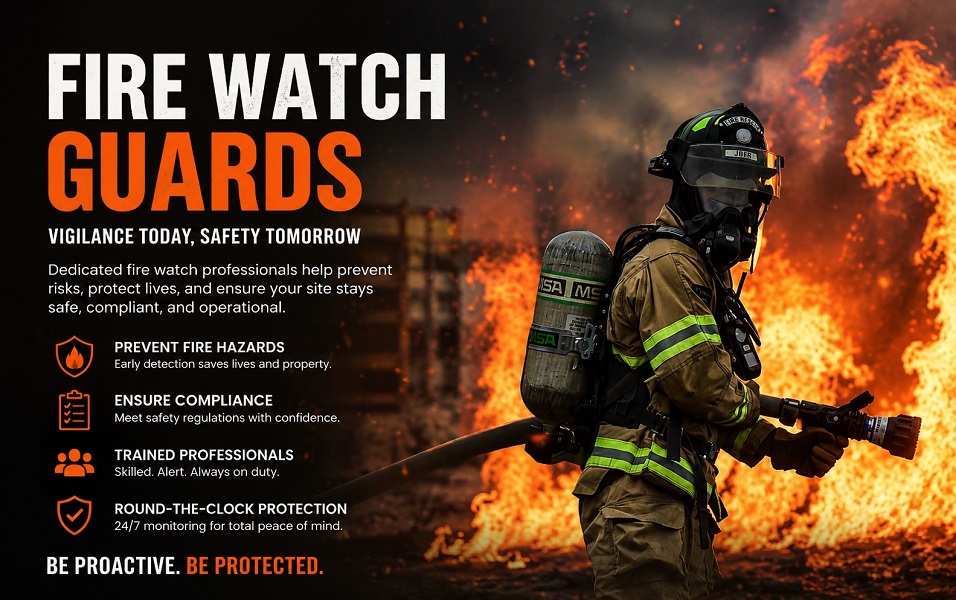
There’s a moment every property owner dreads — the phone call at 2 a.m., the smell of smoke, the realization that a disaster could have been prevented. The smartest building owners across America have already figured out how to stop that call before it ever happens. They hire fire watch guards — and the decision is rarely about fear. It’s about strategy.
The Risk Nobody Talks About Until It’s Too Late
Walk into any commercial building under renovation, any high-rise with a temporarily disabled sprinkler system, or any construction site humming with welding torches and exposed wiring, and you’ll find a quiet but very real danger brewing beneath the surface. Electrical faults, improperly stored chemicals, accumulating debris — these aren’t dramatic scenarios from a disaster film. They’re everyday realities that property owners face across every major U.S. city.
What separates the property owners who suffer catastrophic losses from those who don’t isn’t always luck. It’s foresight. The ones who protect their assets understand that passive fire-detection technology — alarms, sensors, sprinklers — is powerful but not infallible. When those systems go offline for maintenance, repair, or because of flood or electrical damage, there’s a critical window of vulnerability that no algorithm can cover.
That window is exactly where human expertise becomes irreplaceable.
What Fire Watch Guards Actually Do
There’s a widespread misconception that fire watch professionals are simply rent-a-cops with a clipboard. The reality is far more sophisticated. These are trained specialists whose entire focus is identifying, documenting, and responding to fire risks before they escalate into emergencies.
Their work spans everything from routine patrols — walking every floor, every corridor, and every exterior perimeter— to conducting smell-and-touch assessments that no sensor can replicate. They check fire extinguishers, verify that exit signage is properly placed, confirm sprinkler integrity, and maintain detailed logs that stand up to scrutiny from insurance carriers, fire marshals, and OSHA inspectors alike.
Perhaps most critically, their protocol when a fire is detected is immediate and precise: contact the fire department first, then property management. No hesitation, no guesswork, no delay waiting for an automated system to wake up.
When the Law Requires It — and When Smart Owners Go Further
Regulatory compliance isn’t optional, but the most forward-thinking property owners treat fire watch services as a business investment, not just a legal checkbox. Under NFPA Standard LS.01.02.01, a fire watch is mandated when a fire protection system goes out of service for more than four cumulative hours within a 24-hour period. In many jurisdictions, a fire marshal can require certified guards on every affected floor within hours or force a full building evacuation.
OSHA adds another layer. Fire prevention plans must be accessible, posted, and current — and professional fire watch personnel help ensure those plans are not only written but practiced and enforced. New hires must be briefed on potential hazards from day one, and any changes in risk must be communicated across the organization. A lapse isn’t just dangerous — it’s a liability.
But compliance is the floor, not the ceiling. The savviest property owners — those managing luxury apartment complexes, mixed-use developments, or large commercial portfolios — routinely deploy fire watch coverage during hot work operations, water supply interruptions, or periods when unusually large quantities of flammable materials are on-site. They’re not waiting to be told. They’re acting before anyone has to ask.
The Financial Case That Changes Every Conversation
Skeptics often frame fire watch services as an unnecessary overhead expense. That argument collapses the moment you run the numbers. A single commercial fire can cost millions in structural damage, lost inventory, legal exposure, and insurance claims — not counting the reputational damage that no policy ever covers.
Consider the alternative: a licensed, certified fire watch team operating 24/7, conducting regular patrols and filing detailed incident reports, costs a fraction of what a single preventable fire claim would. Beyond the direct cost comparison, there’s the matter of insurance premiums. Properties with documented, professional fire watch coverage during high-risk periods often negotiate better terms with carriers — because the risk profile genuinely changes.
And then there’s liability. If a fire occurs on a property where a watch was legally required and none was deployed, the financial and legal exposure for a property owner can be devastating. Documented fire watch logs serve as evidence of due diligence — evidence that courts and regulators take seriously.
Construction Sites: Where the Stakes Are Highest
No environment carries more concentrated fire risk than an active construction site. Welding sparks, compressed gas cylinders, temporary electrical installations, exposed insulation materials, diesel generators — the list of ignition sources reads like a fire safety training manual.
Many municipalities legally require fire watch guards to remain on-site throughout entire construction phases, until all inspections are cleared and fire protection systems are certified operational. Even where it’s not mandated, responsible site managers know that the presence of a trained professional who spots a smoldering wire or an improperly capped gas line before it becomes a four-alarm emergency is worth every cent of the contract.
Fast-deploying services have evolved to meet this urgency. Leading providers now guarantee nationwide emergency deployment in under two hours, around the clock, 365 days a year — because when a fire system fails, every minute of the exposure window matters.
The Human Element Technology Cannot Replace
Automation has transformed nearly every aspect of property management. Smart sensors, AI-powered surveillance, cloud-connected alarm systems — these are genuinely powerful tools. And yet, the most sophisticated fire detection network on the market cannot smell a gas leak, cannot recognize that a seemingly minor electrical spark is happening in a room full of chemical storage, and cannot make a judgment call about whether to call 911 or wait.
Fire Watch Guards bring something that no software update can replicate: trained human judgment operating in real time, in the physical space where risk actually lives. They carry institutional knowledge of a building’s layout, its vulnerabilities, its traffic patterns. They notice the anomaly. They ask the question. They act.
That’s not sentiment — that’s a measurable operational advantage in the moments that matter most.
What to Look for When Hiring a Provider
Not all fire watch services are created equal, and the quality of the team you hire directly impacts the protection you receive. The baseline standard requires guards who are licensed, certified, and experienced — not general security personnel assigned to fire watch duties as an afterthought.
Look for providers who offer 24/7 availability with rapid deployment capabilities, detailed documentation and reporting practices, and demonstrable familiarity with local fire codes and OSHA requirements. The best services conduct fire risk assessments upon arrival, not just patrol loops. They integrate seamlessly with your existing safety protocols and communicate proactively with property management, not just in the event of an incident.
References matter. A provider with a verified track record across commercial buildings, construction sites, and residential complexes carries a different level of credibility than one with a website and little else. Demand documentation, ask about training standards, and verify that their reporting protocols would hold up under regulatory review.
The Competitive Advantage Nobody Advertises
Here’s what rarely gets discussed in the property management industry: fire watch coverage is increasingly becoming a differentiator in competitive commercial real estate markets. Institutional investors, sophisticated tenants, and major lenders are asking harder questions about risk management protocols than they were a decade ago. Buildings with documented safety programs — including professional fire watch services during vulnerable periods — project a different level of operational maturity.
Tenants in Class A commercial buildings increasingly expect that kind of professionalism. They’re not just leasing square footage; they’re trusting that the building operator has thought through every failure scenario and has a human solution ready when technology falls short.
The property owners who understand this aren’t just protecting their assets. They’re building reputational equity in a market where trust is the most valuable currency of all. The choice to hire trained fire watch professionals isn’t reactive — it’s a statement about how seriously they take everything under their roof.