
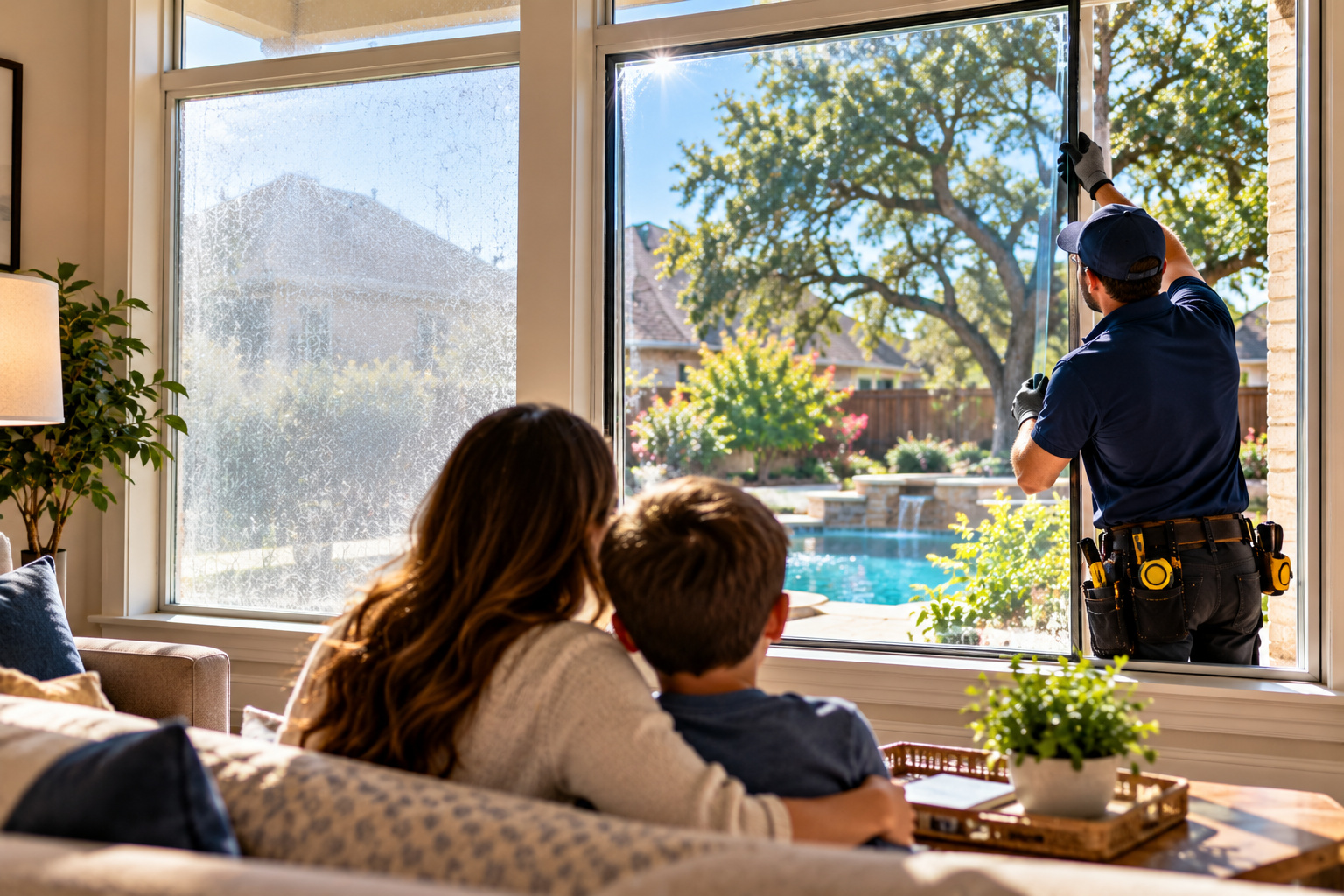
Foggy glass repair fixes cloudy double pane windows for far less than full replacement. See real costs, what causes seal failure, and when repair wins. (151 characters)
TL;DR Most foggy windows are not broken windows. The haze you see sits inside the insulated glass unit, the sealed double pane assembly at the heart of the window. When its edge seal fails, humid air enters the cavity and condenses between the panes. Replacing that sealed unit restores clarity and insulation while keeping the existing frame, sash, hardware, and trim in place. That is why foggy glass repair typically costs $150 to $550 per window, while full window replacement runs $300 to $2,500 per window once labor and finish work are included. Repair also skips the drywall touch ups, repainting, and siding work that replacement often triggers. Replacement earns its price only when the frame has rotted, the window is an aging single pane, or you are upgrading the whole house anyway. This guide explains what causes seal failure, what repair actually involves, and how to decide with real numbers, including what hot climates like Texas do to window seals.
You wipe the glass and the haze stays. That fog sits between the panes, so no cloth will ever reach it. Foggy glass repair solves the problem at a fraction of the cost of new windows, because in most homes the frame is still in perfect shape. The clouded view comes from a failed seal on the insulated glass unit, not from the whole window. Foggy glass repair replaces only that sealed unit, which is why the price gap is so wide. This guide compares both options on cost, energy efficiency, durability, and home value, so you can decide with real numbers instead of a sales pitch.
Quick Answer Foggy glass repair is cheaper because it replaces only the sealed glass unit, not the entire window. A new insulated glass unit typically costs $150 to $550 installed, while full window replacement runs $300 to $2,500 per window. If the frame and sash are sound, repair restores clarity and insulation for a fraction of the price, usually in under an hour per window.
What Is Foggy Glass Repair?
Foggy glass repair is the process of replacing a failed insulated glass unit, the factory sealed double or triple pane assembly inside a window, while leaving the original frame, sash, and trim untouched. When the edge seal on this unit cracks, moisture enters the space between the panes and condenses, creating a permanent fog, haze, or mineral streaking that cannot be cleaned from either side. A technician measures the old unit, orders a matching sealed replacement, and swaps it in place. The result is a clear view and restored insulating performance without the cost or disruption of installing a whole new window.
What Causes Foggy Glass in Double Pane Windows
A double pane window is not one piece of glass. It is an insulated glass unit, often shortened to IGU, made of two panes bonded to an aluminum or warm edge spacer bar. The spacer holds a drying agent called a desiccant, and the cavity between the panes is filled with dry air or argon gas. Two or three layers of sealant lock that dry, inert environment inside.
When the seal cracks, outside air slips into the cavity. The desiccant saturates first, and then humidity begins to condense on the inner faces of the glass. That is the fog you see. It behaves like a cold drink on a humid day, except the droplets are sealed where no rag can reach them.
Why window seals fail
Age and thermal cycling
Most insulated glass seals last 10 to 20 years. Every hot day and cold night makes the panes flex slightly, and the sealant flexes with them. After thousands of cycles, the sealant loses its grip. In Texas, where summer glass temperatures are extreme and air conditioning keeps interior glass cold, the daily flex is larger than in mild climates. West and south facing windows usually fail first for the same reason.
Installation and manufacturing quality
A unit that was sized slightly wrong, or set into a twisted frame, sits under constant stress. Stress cracks seals years early. Manufacturing defects, such as an uneven bead of sealant, shorten the life of even a well installed window.
Water and clogged drainage
Frames have small weep holes that drain rainwater. When those holes clog, water sits against the glass edge and softens the seal from below. This is a common and preventable cause of early failure in humid regions like Houston and the Gulf Coast.
What foggy glass does to your energy bills
A failed unit has usually lost most of its argon fill, and the moist air inside conducts heat faster than the gas did. The U.S. Department of Energy estimates that windows account for roughly 25 to 30 percent of the energy used to heat and cool a typical home, so each failed unit quietly adds to that load. ENERGY STAR notes that upgrading old single pane windows to certified ones can save a typical homeowner between $101 and $583 per year, but you do not need a whole new window to recover most of a failed unit’s lost performance. A matching replacement IGU restores the original sealed cavity, gas fill, and low emissivity coating.
Key point: Foggy glass means the sealed unit inside the window failed. The frame, sash, and hardware are usually still healthy, which is exactly why repair is possible and cheap by comparison.
Foggy Glass Repair vs Window Replacement The Real Cost Comparison
The honest comparison starts with what each option actually buys. Below is a realistic national range for a standard double hung window, based on published contractor pricing.
| Fix | Typical cost per window | Time on site | Clears the fog | Restores insulation | Touch up work after |
| Defogging, drill and vent | $100 to $200 | 1 to 2 hours | Often temporarily | No | None |
| IGU replacement, true foggy glass repair | $150 to $550 | 30 to 60 minutes | Yes, permanently | Yes | None |
| Full window replacement | $300 to $2,500 | 2 to 4 hours | Yes | Yes, plus new frame | Paint, trim, or siding |
What a whole house example looks like
Take a 2005 home in Round Rock with eight fogged windows on the west wall. Glass only repair at $150 to $300 per unit runs roughly $1,200 to $2,400 total. Full replacement at even a modest $500 to $800 per window runs $4,000 to $6,400, before any interior paint or exterior trim work. A premium vinyl or fiberglass replacement package can push past $10,000. The savings from repair land between 60 and 80 percent, and the restored view and insulation are functionally the same as new.
The hidden costs of full replacement
Replacement invoices rarely stop at the window itself. Installers must cut back exterior siding or brick mold, which means caulking and sometimes repainting. Interior casings and stops come off, so drywall or paint touch ups follow. Old homes with plaster or nonstandard rough openings add labor fast. Repair touches none of this, because the existing opening never changes.
Key point: For a sound frame, the price difference between repair and replacement is not a small margin. It is routinely a 50 to 80 percent saving, plus the avoided finish work.
Why Repairing the Glass Costs So Much Less
You keep the most expensive parts
The glass unit is one component of a window system. The frame, sash, balance springs, locks, weatherstripping, trim, and the labor to install them represent most of the cost of a new window. Foggy glass repair keeps all of those parts. You only pay for the sealed unit and a short service visit.
Labor drops from half a day to under an hour
A full replacement means removing the old unit, prepping the opening, insulating, shimming, leveling, sealing the exterior, and finishing the interior. A glass swap means removing the stops, lifting out the failed unit, and setting the new one. Less labor is less money, and less disruption to your home and schedule.
No custom manufacturing wait
Both options involve some lead time, since a replacement IGU is made to your exact measurements. However, a full replacement window is built to order around your rough opening, which often means longer waits and higher material costs for custom sizes. Repair reuses the opening you already have.
Pros and cons of each approach
| Approach | Pros | Cons |
|---|---|---|
| Foggy glass repair, IGU replacement | 50 to 80 percent cheaper, fast service visit, no finish work, restores clarity and insulation, keeps original look | Requires a sound frame, custom unit lead time of several days, only fixes the glass |
| Full window replacement | New frame and hardware, chance to upgrade style and efficiency, addresses rotted or warped components | Much higher cost, interior and exterior touch ups, longer project, higher risk of scope creep |
Key point: Repair is cheaper because the job is smaller, not because the parts are worse. A new sealed IGU with argon fill and a low emissivity coating matches the performance the window had when it was new.
How Foggy Glass Repair Works: Step by Step
Professional foggy glass repair follows a consistent workflow that any reputable glass company should be able to explain to you before starting.
- Inspection. The technician confirms the failure is a broken seal and not surface condensation, and checks the frame and sash for rot or warping.
- Measurement and specification. Thickness, pane count, overall size, tint, spacer type, and any low emissivity coating are recorded. Accuracy here decides whether the new unit fits and matches.
- Custom IGU fabrication. The sealed unit is built to order, usually within several business days.
- Removal. Glazing stops or the sash come out, and the failed unit is lifted free.
- Installation. The new unit is set, sealed, and blocked, then the stops are replaced or the sash is rehung.
- Cleanup and inspection. The glass is cleaned, the window is cycled open and closed, and the work area is left spotless.
Matching your glass specs
A mismatch shows. If the original glass had a low emissivity coating or a bronze tint and the replacement does not, one window will look different from its neighbors in afternoon light. A professional glazier reads the corner logo or etching on the old unit, or checks the National Fenestration Rating Council label if available, and orders a true match.
Key point: The entire repair is a measured swap of one sealed unit. No framing, no drywall, no siding, and usually done in less than an hour per window.
Defogging Kits vs True Glass Repair
Some companies sell a cheaper service that drills small vent holes in the glass, rinses the cavity, and installs vents. It costs less, often $100 to $200 per window, and it can improve the view for a while. The catch is that the failed edge seal is still failed. The unit remains unsealed, so insulation performance does not recover, and the fog often returns within a year or two as conditions shift. Drill and vent work treats the symptom rather than the cause. Treat it as a cosmetic stopgap, and weigh it against a permanent IGU replacement that restores both clarity and the sealed insulating cavity.
When Foggy Glass Repair Is the Right Choice
| Situation | Best move |
| Frame and sash are solid, glass is foggy | IGU replacement, the standard foggy glass repair |
| Two or three foggy windows in an otherwise healthy set | Repair the failed units |
| Historic home with original wood windows | Repair, since matching new frames is costly and often restricted |
| Budget is tight, or you are preparing to list | Repair for maximum visual return per dollar |
| Wood rot around the sill, sash, or frame | Full replacement, possibly with carpentry work |
| Single pane windows, or you want a full efficiency upgrade | Full replacement with certified efficient units |
The pattern is simple. If the failure lives in the glass, repair it. If the failure lives in the frame, replace the window. A replacement IGU seated into a rotted frame will fog again, because water will keep attacking the seal from below.
When Full Window Replacement Makes More Sense
Honesty matters here, because repair is not always the right answer. Replacement is the better investment when the frame shows rot, the sash is warped, the wall around the window has moisture damage, or the hardware no longer locks securely. It is also the right call if your windows are single pane and you want a genuine efficiency upgrade, or if you are renovating and want a new style or color throughout. There is also a timing argument. If the failed seal is one of many problems in a 30 year old window, a second repair in five years may cost more overall than one well chosen replacement now. A good contractor will show you the condition of the frame and let the evidence decide, not the invoice.
How to Make Repaired Windows Last
- Keep frame weep holes clear so water never ponds against the glass edge.
- Inspect exterior caulking once a year and recaulk gaps before rainy seasons.
- Check weatherstripping for wear, since tight sashes reduce the humidity reaching the seal.
- Avoid pressure washing directly at the glass edge, where the stream can force water into the frame.
- Consider solar film or shade for west facing glass in hot climates like Texas to reduce thermal stress.
- Ask for the warranty in writing. Quality replacement IGUs commonly carry 10 to 20 year coverage.
What Homeowners Say on Reddit and Quora
What most people misunderstand
Community threads repeat the same discovery. Many homeowners believe foggy glass means the entire window is finished, and they brace for a five figure replacement quote. Then a glazier tells them the frame is fine and the sealed unit alone can be swapped. The second recurring surprise is that cleaning cannot fix the haze, because the moisture is sealed between the panes. A third is learning that defogging kits and true repair are not the same product, and that the drill and vent method leaves the underlying seal problem unsolved.
Common mistakes
- Accepting a full replacement recommendation without anyone inspecting the frame or sash.
- Trying DIY drain hole kits, which rarely hold up and can crack tempered glass.
- Waiting years to act, letting trapped moisture stain the sash and creep into the frame.
- Forgetting to check the original manufacturer’s glass warranty, which may still cover seal failure.
- Replacing one unit with mismatched glass, leaving a visible tint difference across the wall.
What experienced users and professionals recommend
The consensus from long time homeowners and trades professionals is blunt. Confirm the frame is healthy before anything else. Use a glass specialist rather than a commission driven sales visit. Get the replacement unit warranty in writing, and insist on matching the original coating and tint. Fix all the failed units in a room at the same time so the glass looks uniform. And if anyone quotes a whole house replacement for a problem that appeared in one window, get a second opinion.
People Also Ask
Can foggy glass be repaired without replacing the window?
Yes. If the frame and sash are sound, a glass company replaces only the insulated glass unit and the window looks and performs like new.
How much does it cost to fix a foggy window?
True repair, replacing the sealed unit, typically runs $150 to $550 per window. Defogging services run $100 to $200 but do not restore the seal. Full replacement runs $300 to $2,500.
Why do double pane windows fog up between the panes?
The edge seal of the insulated unit failed, allowing humid air into the cavity. The moisture condenses on the inner glass surfaces where it cannot be cleaned.
How long do double pane window seals last?
Most seals hold for 10 to 20 years. Constant sun exposure and hot climates like Texas tend to shorten that life, especially on west facing windows.
Does foggy glass make energy bills higher?
Somewhat, yes. A failed unit has lost its argon fill, so it insulates worse than intended. Replacing the sealed unit restores the original insulation value.
FAQ
How long does foggy glass repair take?
The on site work is quick. A trained technician usually finishes a single window in 30 to 60 minutes, and a whole house of eight to ten units can often be completed in one visit. The longer part of the timeline is fabrication, because each replacement insulated glass unit is made to your window’s exact measurements. Lead times of several business days are normal, and specialty glass, such as tempered, tinted, or coated units, can take longer. Compare that with full replacement, where each window occupies a crew for two to four hours and often requires return visits for interior trim or paint touch ups. Repair trades a short wait for a dramatically smaller disruption to your home and routine.
Will a repaired window be as energy efficient as a new one?
In most cases, yes. The insulating performance of a double pane window lives inside the sealed unit, in the argon gas fill and the low emissivity coating that reflects heat. When the failed unit is replaced with a matching one, that cavity is sealed and filled again, so the window returns to the performance level it had when it was new. The National Fenestration Rating Council rating on the original window applied to its glass, and the same glass specs restore those numbers. Replacement only wins on efficiency if the frame itself leaks air, the window is an old single pane, or you want to step up to a higher efficiency class entirely. For a failed seal in an otherwise healthy window, a matched IGU replacement is functionally equivalent.
How do I know if my window seal has failed?
The signature sign is fog, haze, or water droplets between the panes that stay put when you clean both accessible surfaces. Early stage failure often looks like a faint milkiness that fades in the warm afternoon and returns at night, because the trapped moisture evaporates and recondenses with temperature swings. As the failure worsens you may see mineral streaks running down the inner glass, a rainbow colored film, or a lens effect where the two panes bow toward each other. None of this appears on the outer surfaces you can touch. Surface condensation that forms on the inside or outside face of the glass during humid mornings is normal and is not seal failure. The problem is only present when the moisture is sealed in the cavity.
Can I prevent my windows from fogging again?
You can reduce the risk, though no seal lasts forever. Keep the weep holes in the frame clear so rain drains instead of pooling against the glass edge. Inspect and refresh exterior caulking each year, and replace worn weatherstripping so the sash closes tightly. Avoid spraying pressure washers at the glass edge, and consider shading or solar control film for windows that take direct afternoon sun, a real factor in Texas heat. Interior humidity control also helps, since the air attacking the seal is damp air. That said, sealant is a consumable component with a working life of roughly 10 to 20 years, so even a well maintained window will eventually need its sealed unit replaced. Maintenance stretches that life, it does not make it infinite.
Does foggy glass lower my home value?
It can, mostly through buyer psychology rather than appraisal math. Cloudy windows read as neglect in listing photos, and buyers often assume a foggy window means an expensive replacement project, even when the actual fix costs a few hundred dollars. Inspectors note failed seals in their reports, and savvy buyers use that line item to negotiate. Before listing, repairing foggy units is one of the highest visual returns per dollar available, because the entire window suddenly photographs and functions like new. Full replacement rarely pays for itself at resale, so repairing the glass and keeping your original windows is usually the stronger financial move for a sale.
A foggy window is almost never a window replacement problem. It is a sealed unit problem, and sealed units are built to be swapped. Because the frame, sash, hardware, and trim stay in place, foggy glass repair costs a fraction of replacement, skips the finish work, and restores the clear view and insulation you lost. Replacement earns its price when the frame itself has failed or when you are upgrading the whole house anyway. Inspect the frame first, match the glass specs, get the warranty in writing, and let the condition of the window, not a sales pitch, make the decision.
Key Takeaways
- Foggy glass comes from a failed seal on the insulated glass unit, not from the whole window.
- IGU replacement typically costs $150 to $550 per window, versus $300 to $2,500 for full replacement.
- Repair keeps the frame, sash, and trim, so there is no drywall, paint, or siding work afterward.
- A matched replacement unit restores the original argon fill, low emissivity coating, and insulation value.
- Defogging kits cost less but leave the seal broken, so fog often returns.
- Replace the window only when the frame is rotted, warped, or water damaged.