
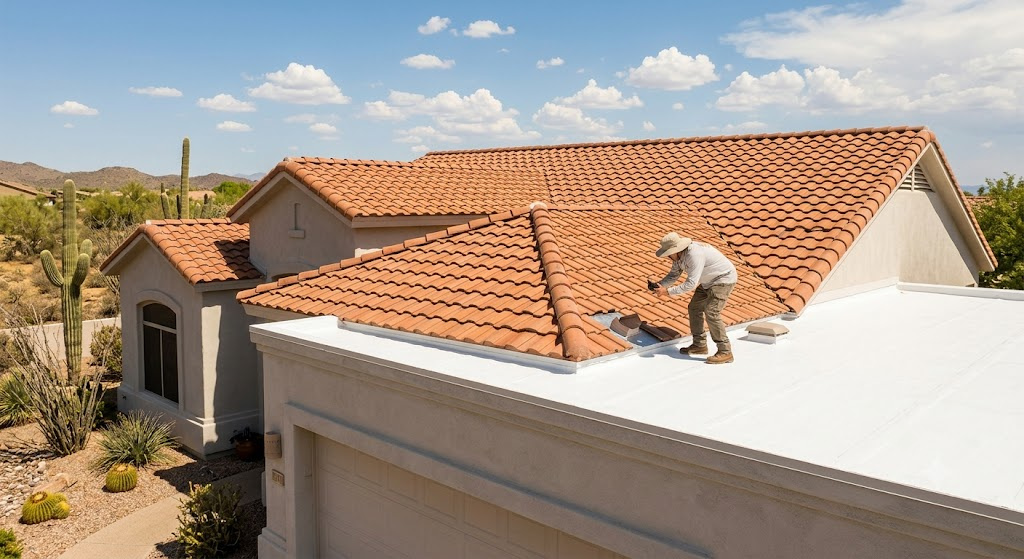
If you own a home in Scottsdale, your roof operates under conditions that would destroy standard roofing materials in a matter of years. Summer afternoon temperatures regularly push past 115°F—driving roof surface temperatures above 160°F—only to be interrupted by sudden, violent monsoon downpours, 60 mph dust storms, and dramatic temperature drops.
Living in the Sonoran Desert means standard roofing rules simply do not apply. Whether you have a classic Southwestern tile roof, a sleek modern spray foam installation, or a flat membrane setup, understanding how desert heat and storms impact your roof can save you tens of thousands of dollars in premature replacements.
The Great Arizona Tile Myth Why Your Roof Might Be Leaking Under “Perfect” Tiles
Walk through any neighborhood in North Scottsdale or Paradise Valley, and you will see row after row of beautiful concrete and clay tile roofs. Most homeowners assume that as long as those tiles look intact, their home is completely protected from water damage.
The reality is that tiles do not waterproof your house.
In Southwestern architecture, concrete and clay tiles act primarily as a heat shield and an aesthetic cover. They block direct ultraviolet radiation and shed the bulk of falling water. The actual water barrier—the layer keeping rain out of your living room—is the underlayment buried beneath those tiles.
How Desert Heat Secretly Destroys Underlayment
While your tiles sit safely on top, heat gets trapped underneath them. Attic space and tile sub-layers act like an oven, cooking the waterproofing membrane year-round:
- Thermal Shock: The rapid shift from 160°F daytime surface temperatures to cooler night conditions causes continuous expansion and contraction. Over time, low-grade felt underlayments become brittle and crack.
- UV and Heat Drying: Traditional organic felt paper (#30 or #40 organic felt) loses its volatile asphalt oils within 10 to 12 years in Arizona. Once dried out, it turns into brittle paper that disintegrates the moment water touches it.
- Debris and Blocked Weep Holes: Dust, debris, and palo verde leaves wash beneath the tiles during storms. If this debris clogs the valley drains or weep holes at the roof edge, standing water backs up directly against deteriorating underlayment.
When monsoon rains hit, water slides right past the tiles, hits the cracked underlayment, and leaks straight into your drywall, ceiling, or fascia boards.
Comparing Popular Desert Roofing Systems
Not all roofing materials handle the Arizona climate the same way. Here is a realistic look at how different materials hold up under local conditions:
| Roofing System | Real-World Lifespan in Scottsdale | Primary Vulnerability | Maintenance Requirements |
| Concrete Tile | Tiles: 50+ Years Underlayment: 12–20 Years | Underlayment drying out; cracked perimeter tiles | Inspection after monsoons; underlayment replacement every 15–20 yrs |
| Clay Tile | Tiles: 75+ Years Underlayment: 15–20 Years | Extremely fragile to walk on; underlayment decay | Specialized contractors only; clear debris from valleys |
| Spray Polyurethane Foam (SPF) | 30+ Years (if maintained) | Direct UV exposure if elastomeric coating wears thin | Fresh protective recoat every 5 to 10 years |
| Architectural Shingle | 12–18 Years | Granule loss, adhesive seal failure in high heat | Periodic nail pop and wind-lift checks |
| Standing Seam Metal | 40–60 Years | Fastener thermal expansion; seam seal fatigue | Minimal; inspect screw rubber washers periodically |
Tile Lift & Relay vs. Full Roof Replacement: Saving Your Original Tiles
One of the most common dilemmas Scottsdale homeowners face is being told they need an entirely new roof simply because they have a leak. In many cases, a full tear-off is an unnecessary expense.
If your concrete or clay tiles are structurally sound, you do not need to buy brand-new tile. Instead, local specialists perform a process called a Tile Lift & Relay:
- Careful Tile Removal: Contractors carefully lift and stack your existing roof tiles on the roof or ground.
- Deck Inspection & Repair: Damaged wood plywood, rotting fascia, and degraded valley metals are replaced.
- Upgraded Underlayment Installation: A high-temperature, modern synthetic or self-adhering rubberized asphalt membrane (modified bitumen) is laid down.
- Re-installation: Your original tiles are re-anchored over the fresh waterproof barrier, restoring the roof to like-new condition.
Working with experienced local professionals like Scottsdale Roofing Pros ensures that your original tiles are preserved and reset correctly, saving you thousands of dollars in material costs while giving your home a brand-new 20+ year waterproof layer.
Flat Roofs and Spray Polyurethane Foam (SPF)
Flat and low-slope roofs are an iconic part of Southwestern modern and Santa Fe style architecture. However, flat roofs do not have the advantage of steep drainage pitch, meaning water management is critical.
Spray Polyurethane Foam (SPF) has become the gold standard for flat roofs in the Valley for two main reasons: seamless waterproofing and unmatched insulation.
The Science of Foam Roofs
SPF is applied as a liquid that expands into a continuous, rigid solid foam layer covering the entire roof deck. Because it has zero seams, vents, flashings, and drains are completely sealed without joints that could pull apart under heat. Furthermore, foam adds significant insulation value (R-value), reducing the heat transferred into your home and noticeably lowering summer air conditioning bills.
The Critical Recoating Schedule
The only true enemy of a foam roof is ultraviolet light. To protect the foam from UV rays, contractors apply a thick elastomeric reflective coating (usually white or tan).
Over 5 to 10 years, Arizona sun slowly wears down this topcoat. If you re-apply a fresh coat of elastomeric sealant before the raw foam becomes exposed, an SPF roof can literally last the lifetime of the building. Neglecting the topcoat, however, allows UV rays to degrade the foam underneath, leading to soft spots and costly repairs.
Preparing Your Roof for Arizona Monsoon Season
Every year between June and September, the Phoenix Metropolitan area experiences monsoon season. High winds, haboobs, microbursts, and heavy rainfall put localized stress on residential structures.
Taking a few preventative steps in early spring can keep your home dry when the storms roll in:
- Clear Roof Valleys and Scuppers: Parapet walls on flat roofs rely on drainage openings called scuppers. If leaves, dust, or bird nests block these openings, water can pool inches deep on your roof, overflowing over the flashing.
- Check Mortar Caps and Trim: Wind can loosen the mortar along tile ridges and hips. Loose mortar lets wind-driven rain slide directly into the attic structure.
- Inspect Tree Branches: Desert trees like Mesquite and Palo Verde grow rapidly during spring. Trim back branches hanging near your roofline; during high monsoon winds, these branches act like sandpaper against your roof surface.
- Look for Slipped Tiles: From the ground, visually scan your roofline. If you see uneven rows or gaps where tiles have slid out of place, call a contractor to reset them before heavy rain arrives.
How to Choose a Qualified Roofing Contractor in Scottsdale
Roofing in Maricopa County requires specialized techniques and strict compliance with local building codes. Before signing a contract, verify that any company you consider meets these key standards:
- Active ROC License: Arizona requires specialized licensing for residential and commercial roofing. Verify that your contractor holds an active license with the Arizona Registrar of Contractors (ROC) and carries full worker’s compensation and liability insurance.
- High-Temperature Material Specifications: Ensure written estimates specifically outline high-heat rated materials. Standard paper underlayments used in midwestern or eastern states will not hold up to Central Arizona temperatures.
- Transparent Labor Warranties: A reputable contractor stands behind their craftsmanship with a written warranty covering both materials and labor. Be wary of quotes that rely solely on manufacturer material warranties, as manufacturer coverage rarely pays for the labor required to fix installation errors.
Frequently Asked Questions
How much does it cost to replace tile roof underlayment in Scottsdale?
Replacing tile underlayment via a “Tile Lift & Relay” generally costs between $4.50 and $8.00 per square foot in the Scottsdale area. Total costs depend on roof slope, height, accessibility, and the quality of the new underlayment selected.
How do I know if my roof leak is coming from broken tiles or failing underlayment?
If water enters your home directly beneath an area with missing or visibly cracked tiles after a storm, it may be a simple tile breakage issue. However, if water stains appear on interior ceilings while the exterior tiles look completely fine, your underlayment has likely reached the end of its functional life and deteriorated.
Can I walk on my tile roof to inspect it myself?
It is strongly recommended that homeowners avoid walking on tile roofs. Arizona sun makes concrete and clay tiles brittle over time, and improper foot placement easily cracks them. If walking on the roof is unavoidable, place your feet only on the bottom third of overlapping tiles where they are supported by framing battens beneath.
How long does a spray foam roof last in Arizona?
An SPF foam roof can last 30 to 50 years or longer, provided it is properly maintained. The key requirement is re-applying a fresh protective elastomeric topcoat every 5 to 10 years to shield the foam from UV breakdown.
What underlayment material is best for desert heat?
Self-adhering, polymer-modified asphalt membranes (often called “peel-and-stick” or modified bitumen) and high-tier woven synthetic underlayments perform best in desert climates. These materials remain flexible under extreme heat and self-seal around nails driven through them during tile installation.