
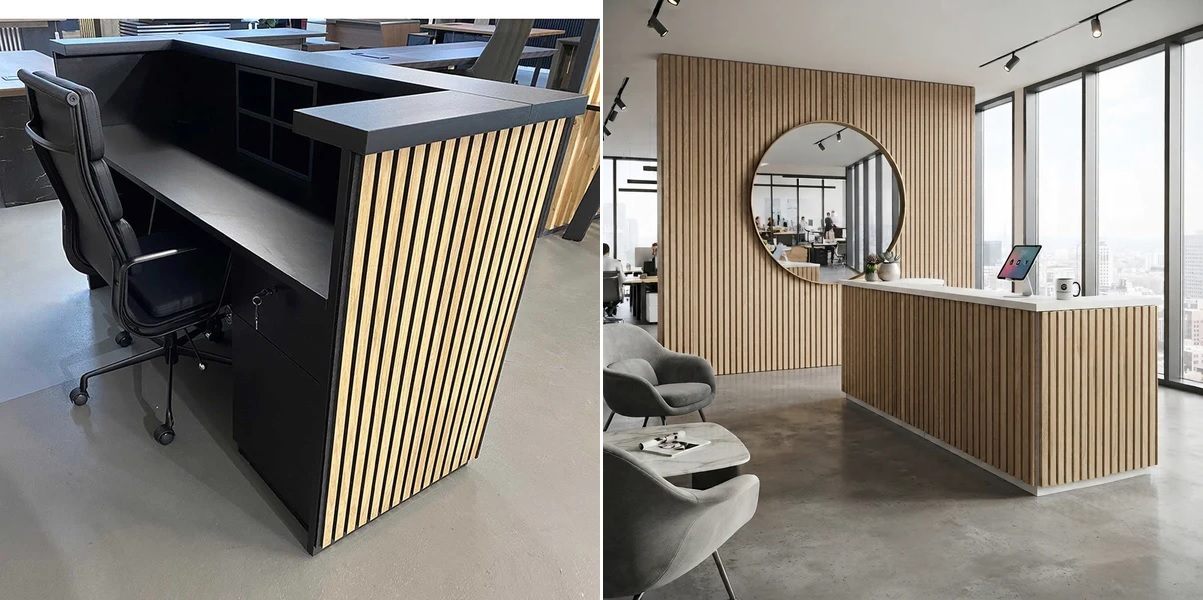
First impressions are formed remarkably quickly. When a client walks into an office, a supplier arrives for a meeting or a prospective employee attends an interview, the reception area is often their first experience of the business in person. A well-planned entrance can communicate professionalism, organisation and attention to detail before a conversation even begins.
At the centre of that experience is the reception desk. It is more than a counter where visitors announce their arrival. It is a working station, a visual focal point, a place for communication and an important part of the office layout. The right desk helps reception staff work efficiently while making visitors feel welcome and confident that they are in the right place.
Choosing one, however, involves more than finding an attractive design. Dimensions, storage, materials, technology, accessibility, privacy, delivery and the overall workplace aesthetic all deserve consideration. A desk that looks perfect online may not suit the room once computers, paperwork, visitors and everyday movement are taken into account.
This practical guide explains how to choose a reception desk that balances appearance with functionality, helping Australian businesses make a more informed furniture decision.
1. Start by Understanding How Your Reception Operates
Before browsing styles or finishes, identify what your reception desk needs to support. Different businesses have different requirements, and those requirements should guide the selection process from the beginning.
A small professional practice may need a compact workstation for one staff member, a computer and occasional visitors. A larger office might require space for several reception employees, multiple monitors, incoming deliveries and a steady flow of appointments. A showroom or customer service centre may have different priorities again.
Consider the activities that take place throughout a normal working day. Reception staff may answer calls, greet visitors, check appointments, receive parcels, organise paperwork, process payments or direct people to meeting rooms. Each activity affects the amount of workspace, storage and equipment access required.
Make a list of the essential tasks and the items staff use regularly. Include computers, monitors, keyboards, telephones, stationery, document trays, payment terminals and any other necessary equipment. Identify what needs to remain on the desktop, what belongs in drawers and what can be stored elsewhere.
This simple assessment helps prevent a common purchasing mistake: selecting a reception desk based on appearance alone, only to discover that it does not provide enough usable workspace for the job.
2. Measure the Room Before Comparing Reception Desks
Accurate measurements are among the most important steps in choosing office reception furniture. A desk needs to fit the available space without making the entrance feel crowded or restricting the movement of staff and visitors.
Measure the width and depth of the proposed desk area. Note the positions of doors, windows, columns, power outlets, wall features and nearby furniture. If the reception desk will sit against a wall, consider skirting boards, wall-mounted equipment and any features that could affect how closely it can be positioned.
Next, consider the space around the desk. Visitors need somewhere to stand while speaking with reception staff, and other people should be able to enter or leave without creating a bottleneck. Staff may also need room to move behind the counter, access storage or turn comfortably between different work areas.
Do not confuse the desk's overall dimensions with its usable work surface. A raised front counter, decorative panels or a shaped configuration can affect the amount of space available for equipment and paperwork. Review the product dimensions carefully and ask for clarification when the information is incomplete.
A simple way to test the proposed layout
Use removable tape to mark the intended desk footprint on the floor. If possible, mark the visitor approach area and nearby furniture as well. Walk through the space as though you were arriving for an appointment, greeting someone at the counter and moving behind the desk.
This practical test can reveal layout problems that are difficult to identify from a product photograph. It is particularly useful in smaller offices, shared entrances and workplaces where several people may arrive at the same time.
3. Choose the Right Reception Desk Configuration
Reception desks are available in several common configurations. The best choice depends on the room shape, the number of staff using the desk and the way the reception area needs to function.
Straight reception desks
A straight reception desk has a simple, linear design that can work well in compact spaces or against a wall. Its straightforward footprint can make furniture planning easier, and its clean appearance often suits contemporary offices.
This configuration may be appropriate where one person works at reception and the main tasks involve greeting visitors, answering calls and using a computer. Check that the available surface still accommodates the equipment and paperwork needed during busy periods.
L-shaped reception desks
An L-shaped reception desk provides two connected sections, potentially creating separate areas for visitor interaction and staff work. One section may be used for greeting visitors while the return provides additional space for a monitor, documents or other equipment.
This arrangement can help organise a workstation, but it requires careful measurement. The return must fit the room without obstructing walkways, and its orientation should suit the location of the entrance and the direction from which visitors approach.
Curved and statement reception desks
Curved or sculptural designs can create a distinctive focal point in a larger foyer. They may suit businesses that want their reception furniture to make a strong contribution to the interior design.
However, the visual shape does not always translate into a straightforward working surface. Check the dimensions and equipment layout carefully to make sure the desk offers practical space as well as visual impact.
Modern feature-front reception desks
Feature-front designs use details such as contrasting finishes, geometric lines, textured panels or distinctive shapes to create visual interest. These options can help establish a contemporary appearance without requiring a complete interior renovation.
When comparing configurations, prioritise the fit between the design, the room and the daily workflow. The most suitable reception desk is the one that performs well in its intended environment, not necessarily the one with the most elaborate appearance.
4. Consider Height, Depth and Staff Comfort
The dimensions of a reception desk influence how comfortable it is to use and how easily staff can interact with visitors. Overall width is only one part of the decision. Height, depth, legroom and the arrangement of the work surface are also important.
Consider where monitors will sit, how much room is needed for a keyboard and mouse, and whether staff will regularly write notes or handle documents. Equipment placed too close together can make a workstation feel cluttered, while an unnecessarily deep work surface may place frequently used items inconveniently far away.
Think about the people who will use the desk. If reception is staffed for long periods, the working arrangement should support a comfortable posture and allow staff to use their equipment without repeatedly twisting or reaching awkwardly. A desk should be assessed alongside the chair, monitor position and the wider workstation setup.
Where several employees share reception duties, consider whether the workstation can accommodate different working preferences and equipment arrangements. The aim is to create a practical environment that supports the work rather than forcing staff to adapt to an unsuitable layout.
For visitor interaction, consider the height and shape of the front counter. The most appropriate arrangement will depend on the service being provided and the needs of visitors. If accessible interaction is required, investigate the relevant design considerations before choosing a model.
5. Plan Accessibility and Inclusive Visitor Experiences
A reception area should be easy to approach and use. Visitors may have different mobility, vision, hearing or communication needs, and thoughtful planning can make the arrival experience more straightforward for a wider range of people.
Consider the route from the entrance to the reception point, the space available to approach the counter and whether furniture creates unnecessary obstacles. Keep access routes clear and think about how visitors using mobility aids can move through the area.
The desk itself is only one part of the overall arrangement. Signage, lighting, the location of waiting chairs and the way staff communicate with visitors can all influence how welcoming and usable the reception feels.
Businesses undertaking a new fit-out or modifying an existing premises should check the applicable Australian accessibility requirements and seek suitable professional advice where necessary. Do not assume that a standard desk automatically meets every project's accessibility needs.
Planning for accessibility early is generally easier than trying to resolve layout problems after furniture has been delivered and installed.
6. Make Storage Part of the Buying Decision
The visitor-facing side of a reception desk may create the first impression, but the staff side determines how effectively the desk supports everyday work. Without sufficient storage, even a stylish reception area can quickly become cluttered.
Consider the items that need to be stored within easy reach. These may include stationery, appointment records, forms, files, spare cables, office supplies and small pieces of equipment. The amount of storage required will depend on the business and the activities performed at reception.
Drawers can keep frequently used items organised, while cupboards or shelves may suit larger supplies. Lockable storage can be useful where confidential documents or valuable items need to be secured. Confirm which features are actually included with the desk, as storage arrangements differ between models.
Think about how the storage will be used rather than simply counting drawers. A compartment that is difficult to access or poorly suited to the items being stored may provide limited practical value.
It can also be helpful to separate the reception workstation from general office storage. Items used only occasionally may be better kept in a nearby cabinet, leaving the desk clear for essential tasks and visitor interactions.
7. Check Cable Management and Technology Requirements
Modern reception areas often contain more technology than is immediately obvious. Computers, monitors, telephones, printers, payment terminals, chargers and network equipment may all need power or data connections.
Without a plan, cables can become tangled, interfere with cleaning and make the workstation look untidy. In some layouts, poorly routed cables may also create a trip hazard or restrict access around the desk.
Before choosing a reception desk, check whether the design includes cable access holes, routing channels or suitable space for power boards and connected devices. Do not assume these features are included unless the product information confirms them.
Map out where the equipment will sit and where the available power outlets are located. Consider whether cables can be routed neatly without crossing visitor walkways or becoming stretched across the floor.
Allow some flexibility for future changes. A business might add a second monitor, replace its computer system or introduce new reception technology. A desk arrangement that can accommodate modest changes may remain useful for longer than one designed around a very restrictive layout.
For electrical installations or changes to power access, use appropriately qualified professionals where required and ensure the finished setup is safe and suitable for the workplace.
8. Select Materials and Finishes for Your Workplace
The material and finish of a reception desk influence its appearance, maintenance and suitability for daily use. The right choice should complement the office interior while meeting the practical demands of the reception area.
Timber-look finishes can introduce warmth into a professional space. Neutral finishes may create a clean and understated appearance, while contrasting panels or darker tones can give the reception counter greater visual definition. The best option depends on the existing flooring, wall colours, lighting and furniture.
Consider the amount of use the desk will receive. A busy reception counter may be exposed to fingerprints, dust, stationery, bags and frequent cleaning. Some finishes show marks more readily than others, so it is worth asking about routine care and the manufacturer's cleaning recommendations.
Review the product details rather than relying solely on photographs. Check the stated materials, finish, dimensions and any available care instructions. If the business has specific expectations around durability or maintenance, ask the retailer to clarify whether the product is suitable for the intended environment.
Also consider how the finish will work with future changes to the office. A coordinated, relatively timeless design may be easier to incorporate if the business later updates its chairs, flooring or wall colours.
9. Create a Consistent Brand Impression
A reception desk contributes to the way visitors perceive a business. Its design, colour and placement should support the brand's identity without making the room feel overdesigned.
A professional services firm may prefer a restrained, polished appearance. A creative business might choose more distinctive shapes or contrasting finishes, while a company with a strong natural or industrial aesthetic may favour different textures and colours.
Look at the existing visual elements before making a decision. Consider the company logo, signage, wall colours, flooring, lighting and nearby furniture. A desk that complements these elements can help the reception area feel cohesive and intentional.
Branding does not need to be complicated. Clear signage, a tidy counter and a consistent colour palette can be more effective than filling every available surface with decorative elements.
Think about the message the space should communicate. Should it feel welcoming, discreet, premium, practical or innovative? Use that objective to guide the shortlist and assess each option against the overall design rather than judging the desk in isolation.
10. Improve Lighting, Privacy and Visitor Flow
A reception desk functions within a larger environment. Lighting, acoustics, waiting arrangements and visitor movement can influence the experience just as much as the furniture itself.
Lighting should make the reception point easy to identify and support staff tasks. Avoid excessive glare on monitors or surfaces that makes it uncomfortable to read documents. If the desk is positioned near windows, consider how natural light changes throughout the day.
Privacy deserves attention too. Reception staff may handle contact details, appointment information or business documents. Position computer screens and paperwork thoughtfully, and consider whether the desk layout makes confidential conversations unnecessarily audible to people waiting nearby.
Visitor flow should feel intuitive. People entering the building should be able to recognise where to go without needing to navigate around furniture or guess where they should stand. If several visitors may arrive together, make sure the layout provides enough room for them to wait without blocking the entrance.
Where space allows, define a clear relationship between the reception counter, waiting chairs and the route to meeting rooms or other parts of the office. A well-organised layout helps the area feel calmer, even during busy periods.
11. Match the Desk to the Type of Business
There is no single reception desk design that suits every workplace. The most effective choice reflects the services provided, the people visiting the business and the tasks reception staff perform.
Professional offices
Consultancies, accounting firms, legal practices and other professional workplaces may benefit from a reception area that feels organised and composed. Storage, a tidy workstation, clear signage and a coordinated finish can help establish a professional atmosphere.
Medical and allied health practices
These environments may have specific needs around visitor privacy, paperwork, equipment and the movement of people through the waiting area. Consider the entire reception workflow and confirm any relevant requirements before choosing furniture.
Showrooms and customer-facing businesses
A showroom reception may need to accommodate customer enquiries, product information and regular movement through the space. The desk should be visible and approachable without competing with the products or obstructing circulation.
Small offices and shared workspaces
Where floor space is limited, a compact reception desk may be preferable to a large statement piece. Prioritise essential functions, practical storage and a layout that leaves enough room for people to enter and move around comfortably.
These examples illustrate why it is useful to define the business's requirements first. A design that performs well in one setting may be unnecessarily large, impractical or visually unsuitable in another.
12. Compare Total Cost, Not Just the Advertised Price
Budget is an important part of selecting office reception furniture, but the advertised price does not always tell the whole story. Compare each option against its included features, suitability and the practical costs of getting it into service.
Check whether the quoted price includes the configuration shown, the selected finish and any storage or accessories pictured. Product photographs can illustrate a styled environment, so verify what is included rather than assuming every visible item comes with the desk.
Ask about delivery arrangements, access restrictions, assembly requirements and any additional charges that may apply. A desk intended for a particular location must be able to reach the installation area through the available doors, corridors, lifts or stairways.
It is useful to compare several suitable options using the same checklist. One desk may have a lower initial price but require additional storage, while another may offer a more practical arrangement for the intended workflow.
Consider the consequences of an unsuitable purchase as well. Replacing a desk that does not fit the space or accommodate essential equipment can cost more time and money than planning properly at the beginning.
13. Plan Delivery and Installation Before Ordering
Furniture delivery is easy to overlook when attention is focused on design, but it can be an important part of a successful office fit-out.
Measure the route from the delivery point to the proposed installation area. Check door widths, corridor turns, lift dimensions and any restrictions that could affect the movement of large furniture. If the building has loading dock rules, delivery time windows or access procedures, confirm them in advance.
Ask the retailer about the delivery method, assembly requirements and any preparation needed before arrival. If the desk will be installed as part of a larger renovation, coordinate delivery with the schedule for flooring, painting, electrical work and other furniture.
Allow time to inspect the delivery and address any issues before the reception area needs to be operational. Planning these details early helps reduce the risk of delays and last-minute changes.
14. Where to Find Reception Desks for a Modern Office
Once the practical requirements are clear, comparing a dedicated range of office reception furniture can help narrow the options. Look for clear product information covering dimensions, configuration, finishes and the features included with each design.
Browsing office reception desks provides a starting point for comparing styles and identifying designs that may suit different workplace layouts. Use your measurements, equipment list and preferred aesthetic to assess the available options rather than choosing from appearance alone.
If important details are missing, ask the retailer for clarification before placing an order. Questions about dimensions, storage, cable access, materials, delivery or assembly are easier to resolve before a purchase than after the furniture arrives.
For a new office or a broader commercial fit-out, consider the desk alongside the waiting chairs, storage furniture, signage and other elements of the reception area. Coordinating these choices can help create a consistent appearance while making efficient use of the available space.
15. Common Reception Desk Buying Mistakes
Even a well-intentioned furniture purchase can become frustrating when important details are overlooked. The following mistakes are worth avoiding.
- Choosing by appearance alone: An attractive desk still needs to support the daily work carried out at reception.
- Guessing the dimensions: Measure the room, the proposed footprint and the delivery route before ordering.
- Underestimating storage: Account for documents, stationery, equipment and anything that needs to be kept secure.
- Ignoring cable management: Plan the position of computers, power access and connected devices before installation.
- Overlooking visitor movement: Make sure the desk does not create unnecessary congestion near the entrance.
- Assuming features are included: Verify the details of drawers, locks, cable access and accessories.
- Neglecting accessibility: Consider the needs of different visitors and check relevant requirements for the premises.
- Forgetting delivery access: Confirm that the desk can reach the installation area and that the building's delivery arrangements are suitable.
- Failing to coordinate the interior: Consider the desk alongside lighting, flooring, signage and other furniture.
A little preparation can eliminate many of these problems. The goal is not to make the buying process unnecessarily complicated, but to ensure the chosen desk works well in the actual space.
16. Reception Desk Buying Checklist
Before making your final decision, use this checklist to review the key considerations.
- Have you identified the tasks performed at reception?
- Have you measured the room and the available desk footprint?
- Have you checked the desk's overall dimensions and usable work surface?
- Is there enough space for staff, visitors and nearby furniture?
- Does the configuration suit the entrance and the room layout?
- Can the desk accommodate computers, monitors and other required equipment?
- Is the storage arrangement suitable for everyday supplies and documents?
- Have you checked cable access and power requirements?
- Does the finish complement the workplace and suit its maintenance needs?
- Have you considered visitor privacy and accessibility?
- Are the product specifications and included features clear?
- Have you compared the total cost, including relevant delivery and assembly arrangements?
- Can the furniture be moved through the building to the installation area?
- Does the desk support the professional impression you want the business to create?
If you can answer these questions confidently, you will have a much stronger basis for choosing a reception desk that suits your business.
Final Thoughts: Choose a Reception Desk That Works as Well as It Looks
The right reception desk brings together appearance, practicality and a positive visitor experience. It should fit the room, support the people who work at it, accommodate the necessary equipment and contribute to a professional and welcoming entrance.
Start with the way the reception operates, measure the available space and compare configurations against your actual needs. Then consider materials, storage, technology, privacy, accessibility, branding and delivery. These details may not all be obvious in a product photograph, but they can make a substantial difference to the desk's usefulness once it is installed.
Whether you are furnishing a small professional practice or planning a larger office fit-out, a thoughtful selection process helps you make a more informed decision. By balancing design with everyday requirements, you can create a reception area that looks considered, functions efficiently and gives visitors a confident first impression of your business.
How to Choose the Right Reception Desk for a Modern Office
First impressions are formed remarkably quickly. When a client walks into an office, a supplier arrives for a meeting or a prospective employee attends an interview, the reception area is often their first experience of the business in person. A well-planned entrance can communicate professionalism, organisation and attention to detail before a conversation even begins.
At the centre of that experience is the reception desk. It is more than a counter where visitors announce their arrival. It is a working station, a visual focal point, a place for communication and an important part of the office layout. The right desk helps reception staff work efficiently while making visitors feel welcome and confident that they are in the right place.
Choosing one, however, involves more than finding an attractive design. Dimensions, storage, materials, technology, accessibility, privacy, delivery and the overall workplace aesthetic all deserve consideration. A desk that looks perfect online may not suit the room once computers, paperwork, visitors and everyday movement are taken into account.
This practical guide explains how to choose a reception desk that balances appearance with functionality, helping Australian businesses make a more informed furniture decision.
1. Start by Understanding How Your Reception Operates
Before browsing styles or finishes, identify what your reception desk needs to support. Different businesses have different requirements, and those requirements should guide the selection process from the beginning.
A small professional practice may need a compact workstation for one staff member, a computer and occasional visitors. A larger office might require space for several reception employees, multiple monitors, incoming deliveries and a steady flow of appointments. A showroom or customer service centre may have different priorities again.
Consider the activities that take place throughout a normal working day. Reception staff may answer calls, greet visitors, check appointments, receive parcels, organise paperwork, process payments or direct people to meeting rooms. Each activity affects the amount of workspace, storage and equipment access required.
Make a list of the essential tasks and the items staff use regularly. Include computers, monitors, keyboards, telephones, stationery, document trays, payment terminals and any other necessary equipment. Identify what needs to remain on the desktop, what belongs in drawers and what can be stored elsewhere.
This simple assessment helps prevent a common purchasing mistake: selecting a reception desk based on appearance alone, only to discover that it does not provide enough usable workspace for the job.
2. Measure the Room Before Comparing Reception Desks
Accurate measurements are among the most important steps in choosing office reception furniture. A desk needs to fit the available space without making the entrance feel crowded or restricting the movement of staff and visitors.
Measure the width and depth of the proposed desk area. Note the positions of doors, windows, columns, power outlets, wall features and nearby furniture. If the reception desk will sit against a wall, consider skirting boards, wall-mounted equipment and any features that could affect how closely it can be positioned.
Next, consider the space around the desk. Visitors need somewhere to stand while speaking with reception staff, and other people should be able to enter or leave without creating a bottleneck. Staff may also need room to move behind the counter, access storage or turn comfortably between different work areas.
Do not confuse the desk's overall dimensions with its usable work surface. A raised front counter, decorative panels or a shaped configuration can affect the amount of space available for equipment and paperwork. Review the product dimensions carefully and ask for clarification when the information is incomplete.
A simple way to test the proposed layout
Use removable tape to mark the intended desk footprint on the floor. If possible, mark the visitor approach area and nearby furniture as well. Walk through the space as though you were arriving for an appointment, greeting someone at the counter and moving behind the desk.
This practical test can reveal layout problems that are difficult to identify from a product photograph. It is particularly useful in smaller offices, shared entrances and workplaces where several people may arrive at the same time.
3. Choose the Right Reception Desk Configuration
Reception desks are available in several common configurations. The best choice depends on the room shape, the number of staff using the desk and the way the reception area needs to function.
Straight reception desks
A straight reception desk has a simple, linear design that can work well in compact spaces or against a wall. Its straightforward footprint can make furniture planning easier, and its clean appearance often suits contemporary offices.
This configuration may be appropriate where one person works at reception and the main tasks involve greeting visitors, answering calls and using a computer. Check that the available surface still accommodates the equipment and paperwork needed during busy periods.
L-shaped reception desks
An L-shaped reception desk provides two connected sections, potentially creating separate areas for visitor interaction and staff work. One section may be used for greeting visitors while the return provides additional space for a monitor, documents or other equipment.
This arrangement can help organise a workstation, but it requires careful measurement. The return must fit the room without obstructing walkways, and its orientation should suit the location of the entrance and the direction from which visitors approach.
Curved and statement reception desks
Curved or sculptural designs can create a distinctive focal point in a larger foyer. They may suit businesses that want their reception furniture to make a strong contribution to the interior design.
However, the visual shape does not always translate into a straightforward working surface. Check the dimensions and equipment layout carefully to make sure the desk offers practical space as well as visual impact.
Modern feature-front reception desks
Feature-front designs use details such as contrasting finishes, geometric lines, textured panels or distinctive shapes to create visual interest. These options can help establish a contemporary appearance without requiring a complete interior renovation.
When comparing configurations, prioritise the fit between the design, the room and the daily workflow. The most suitable reception desk is the one that performs well in its intended environment, not necessarily the one with the most elaborate appearance.
4. Consider Height, Depth and Staff Comfort
The dimensions of a reception desk influence how comfortable it is to use and how easily staff can interact with visitors. Overall width is only one part of the decision. Height, depth, legroom and the arrangement of the work surface are also important.
Consider where monitors will sit, how much room is needed for a keyboard and mouse, and whether staff will regularly write notes or handle documents. Equipment placed too close together can make a workstation feel cluttered, while an unnecessarily deep work surface may place frequently used items inconveniently far away.
Think about the people who will use the desk. If reception is staffed for long periods, the working arrangement should support a comfortable posture and allow staff to use their equipment without repeatedly twisting or reaching awkwardly. A desk should be assessed alongside the chair, monitor position and the wider workstation setup.
Where several employees share reception duties, consider whether the workstation can accommodate different working preferences and equipment arrangements. The aim is to create a practical environment that supports the work rather than forcing staff to adapt to an unsuitable layout.
For visitor interaction, consider the height and shape of the front counter. The most appropriate arrangement will depend on the service being provided and the needs of visitors. If accessible interaction is required, investigate the relevant design considerations before choosing a model.
5. Plan Accessibility and Inclusive Visitor Experiences
A reception area should be easy to approach and use. Visitors may have different mobility, vision, hearing or communication needs, and thoughtful planning can make the arrival experience more straightforward for a wider range of people.
Consider the route from the entrance to the reception point, the space available to approach the counter and whether furniture creates unnecessary obstacles. Keep access routes clear and think about how visitors using mobility aids can move through the area.
The desk itself is only one part of the overall arrangement. Signage, lighting, the location of waiting chairs and the way staff communicate with visitors can all influence how welcoming and usable the reception feels.
Businesses undertaking a new fit-out or modifying an existing premises should check the applicable Australian accessibility requirements and seek suitable professional advice where necessary. Do not assume that a standard desk automatically meets every project's accessibility needs.
Planning for accessibility early is generally easier than trying to resolve layout problems after furniture has been delivered and installed.
6. Make Storage Part of the Buying Decision
The visitor-facing side of a reception desk may create the first impression, but the staff side determines how effectively the desk supports everyday work. Without sufficient storage, even a stylish reception area can quickly become cluttered.
Consider the items that need to be stored within easy reach. These may include stationery, appointment records, forms, files, spare cables, office supplies and small pieces of equipment. The amount of storage required will depend on the business and the activities performed at reception.
Drawers can keep frequently used items organised, while cupboards or shelves may suit larger supplies. Lockable storage can be useful where confidential documents or valuable items need to be secured. Confirm which features are actually included with the desk, as storage arrangements differ between models.
Think about how the storage will be used rather than simply counting drawers. A compartment that is difficult to access or poorly suited to the items being stored may provide limited practical value.
It can also be helpful to separate the reception workstation from general office storage. Items used only occasionally may be better kept in a nearby cabinet, leaving the desk clear for essential tasks and visitor interactions.
7. Check Cable Management and Technology Requirements
Modern reception areas often contain more technology than is immediately obvious. Computers, monitors, telephones, printers, payment terminals, chargers and network equipment may all need power or data connections.
Without a plan, cables can become tangled, interfere with cleaning and make the workstation look untidy. In some layouts, poorly routed cables may also create a trip hazard or restrict access around the desk.
Before choosing a reception desk, check whether the design includes cable access holes, routing channels or suitable space for power boards and connected devices. Do not assume these features are included unless the product information confirms them.
Map out where the equipment will sit and where the available power outlets are located. Consider whether cables can be routed neatly without crossing visitor walkways or becoming stretched across the floor.
Allow some flexibility for future changes. A business might add a second monitor, replace its computer system or introduce new reception technology. A desk arrangement that can accommodate modest changes may remain useful for longer than one designed around a very restrictive layout.
For electrical installations or changes to power access, use appropriately qualified professionals where required and ensure the finished setup is safe and suitable for the workplace.
8. Select Materials and Finishes for Your Workplace
The material and finish of a reception desk influence its appearance, maintenance and suitability for daily use. The right choice should complement the office interior while meeting the practical demands of the reception area.
Timber-look finishes can introduce warmth into a professional space. Neutral finishes may create a clean and understated appearance, while contrasting panels or darker tones can give the reception counter greater visual definition. The best option depends on the existing flooring, wall colours, lighting and furniture.
Consider the amount of use the desk will receive. A busy reception counter may be exposed to fingerprints, dust, stationery, bags and frequent cleaning. Some finishes show marks more readily than others, so it is worth asking about routine care and the manufacturer's cleaning recommendations.
Review the product details rather than relying solely on photographs. Check the stated materials, finish, dimensions and any available care instructions. If the business has specific expectations around durability or maintenance, ask the retailer to clarify whether the product is suitable for the intended environment.
Also consider how the finish will work with future changes to the office. A coordinated, relatively timeless design may be easier to incorporate if the business later updates its chairs, flooring or wall colours.
9. Create a Consistent Brand Impression
A reception desk contributes to the way visitors perceive a business. Its design, colour and placement should support the brand's identity without making the room feel overdesigned.
A professional services firm may prefer a restrained, polished appearance. A creative business might choose more distinctive shapes or contrasting finishes, while a company with a strong natural or industrial aesthetic may favour different textures and colours.
Look at the existing visual elements before making a decision. Consider the company logo, signage, wall colours, flooring, lighting and nearby furniture. A desk that complements these elements can help the reception area feel cohesive and intentional.
Branding does not need to be complicated. Clear signage, a tidy counter and a consistent colour palette can be more effective than filling every available surface with decorative elements.
Think about the message the space should communicate. Should it feel welcoming, discreet, premium, practical or innovative? Use that objective to guide the shortlist and assess each option against the overall design rather than judging the desk in isolation.
10. Improve Lighting, Privacy and Visitor Flow
A reception desk functions within a larger environment. Lighting, acoustics, waiting arrangements and visitor movement can influence the experience just as much as the furniture itself.
Lighting should make the reception point easy to identify and support staff tasks. Avoid excessive glare on monitors or surfaces that makes it uncomfortable to read documents. If the desk is positioned near windows, consider how natural light changes throughout the day.
Privacy deserves attention too. Reception staff may handle contact details, appointment information or business documents. Position computer screens and paperwork thoughtfully, and consider whether the desk layout makes confidential conversations unnecessarily audible to people waiting nearby.
Visitor flow should feel intuitive. People entering the building should be able to recognise where to go without needing to navigate around furniture or guess where they should stand. If several visitors may arrive together, make sure the layout provides enough room for them to wait without blocking the entrance.
Where space allows, define a clear relationship between the reception counter, waiting chairs and the route to meeting rooms or other parts of the office. A well-organised layout helps the area feel calmer, even during busy periods.
11. Match the Desk to the Type of Business
There is no single reception desk design that suits every workplace. The most effective choice reflects the services provided, the people visiting the business and the tasks reception staff perform.
Professional offices
Consultancies, accounting firms, legal practices and other professional workplaces may benefit from a reception area that feels organised and composed. Storage, a tidy workstation, clear signage and a coordinated finish can help establish a professional atmosphere.
Medical and allied health practices
These environments may have specific needs around visitor privacy, paperwork, equipment and the movement of people through the waiting area. Consider the entire reception workflow and confirm any relevant requirements before choosing furniture.
Showrooms and customer-facing businesses
A showroom reception may need to accommodate customer enquiries, product information and regular movement through the space. The desk should be visible and approachable without competing with the products or obstructing circulation.
Small offices and shared workspaces
Where floor space is limited, a compact reception desk may be preferable to a large statement piece. Prioritise essential functions, practical storage and a layout that leaves enough room for people to enter and move around comfortably.
These examples illustrate why it is useful to define the business's requirements first. A design that performs well in one setting may be unnecessarily large, impractical or visually unsuitable in another.
12. Compare Total Cost, Not Just the Advertised Price
Budget is an important part of selecting office reception furniture, but the advertised price does not always tell the whole story. Compare each option against its included features, suitability and the practical costs of getting it into service.
Check whether the quoted price includes the configuration shown, the selected finish and any storage or accessories pictured. Product photographs can illustrate a styled environment, so verify what is included rather than assuming every visible item comes with the desk.
Ask about delivery arrangements, access restrictions, assembly requirements and any additional charges that may apply. A desk intended for a particular location must be able to reach the installation area through the available doors, corridors, lifts or stairways.
It is useful to compare several suitable options using the same checklist. One desk may have a lower initial price but require additional storage, while another may offer a more practical arrangement for the intended workflow.
Consider the consequences of an unsuitable purchase as well. Replacing a desk that does not fit the space or accommodate essential equipment can cost more time and money than planning properly at the beginning.
13. Plan Delivery and Installation Before Ordering
Furniture delivery is easy to overlook when attention is focused on design, but it can be an important part of a successful office fit-out.
Measure the route from the delivery point to the proposed installation area. Check door widths, corridor turns, lift dimensions and any restrictions that could affect the movement of large furniture. If the building has loading dock rules, delivery time windows or access procedures, confirm them in advance.
Ask the retailer about the delivery method, assembly requirements and any preparation needed before arrival. If the desk will be installed as part of a larger renovation, coordinate delivery with the schedule for flooring, painting, electrical work and other furniture.
Allow time to inspect the delivery and address any issues before the reception area needs to be operational. Planning these details early helps reduce the risk of delays and last-minute changes.
14. Where to Find Reception Desks for a Modern Office
Once the practical requirements are clear, comparing a dedicated range of office reception furniture can help narrow the options. Look for clear product information covering dimensions, configuration, finishes and the features included with each design.
Browsing office reception desks provides a starting point for comparing styles and identifying designs that may suit different workplace layouts. Use your measurements, equipment list and preferred aesthetic to assess the available options rather than choosing from appearance alone.
If important details are missing, ask the retailer for clarification before placing an order. Questions about dimensions, storage, cable access, materials, delivery or assembly are easier to resolve before a purchase than after the furniture arrives.
For a new office or a broader commercial fit-out, consider the desk alongside the waiting chairs, storage furniture, signage and other elements of the reception area. Coordinating these choices can help create a consistent appearance while making efficient use of the available space.
15. Common Reception Desk Buying Mistakes
Even a well-intentioned furniture purchase can become frustrating when important details are overlooked. The following mistakes are worth avoiding.
- Choosing by appearance alone: An attractive desk still needs to support the daily work carried out at reception.
- Guessing the dimensions: Measure the room, the proposed footprint and the delivery route before ordering.
- Underestimating storage: Account for documents, stationery, equipment and anything that needs to be kept secure.
- Ignoring cable management: Plan the position of computers, power access and connected devices before installation.
- Overlooking visitor movement: Make sure the desk does not create unnecessary congestion near the entrance.
- Assuming features are included: Verify the details of drawers, locks, cable access and accessories.
- Neglecting accessibility: Consider the needs of different visitors and check relevant requirements for the premises.
- Forgetting delivery access: Confirm that the desk can reach the installation area and that the building's delivery arrangements are suitable.
- Failing to coordinate the interior: Consider the desk alongside lighting, flooring, signage and other furniture.
A little preparation can eliminate many of these problems. The goal is not to make the buying process unnecessarily complicated, but to ensure the chosen desk works well in the actual space.
16. Reception Desk Buying Checklist
Before making your final decision, use this checklist to review the key considerations.
- Have you identified the tasks performed at reception?
- Have you measured the room and the available desk footprint?
- Have you checked the desk's overall dimensions and usable work surface?
- Is there enough space for staff, visitors and nearby furniture?
- Does the configuration suit the entrance and the room layout?
- Can the desk accommodate computers, monitors and other required equipment?
- Is the storage arrangement suitable for everyday supplies and documents?
- Have you checked cable access and power requirements?
- Does the finish complement the workplace and suit its maintenance needs?
- Have you considered visitor privacy and accessibility?
- Are the product specifications and included features clear?
- Have you compared the total cost, including relevant delivery and assembly arrangements?
- Can the furniture be moved through the building to the installation area?
- Does the desk support the professional impression you want the business to create?
If you can answer these questions confidently, you will have a much stronger basis for choosing a reception desk that suits your business.
Final Thoughts: Choose a Reception Desk That Works as Well as It Looks
The right reception desk brings together appearance, practicality and a positive visitor experience. It should fit the room, support the people who work at it, accommodate the necessary equipment and contribute to a professional and welcoming entrance.
Start with the way the reception operates, measure the available space and compare configurations against your actual needs. Then consider materials, storage, technology, privacy, accessibility, branding and delivery. These details may not all be obvious in a product photograph, but they can make a substantial difference to the desk's usefulness once it is installed.
Whether you are furnishing a small professional practice or planning a larger office fit-out, a thoughtful selection process helps you make a more informed decision. By balancing design with everyday requirements, you can create a reception area that looks considered, functions efficiently and gives visitors a confident first impression of your business.